
Tiny's Second CNS Lab FoodPrint200+ Test!
One of the blog posts that I most frequently share with people is Tiny’s Review of Cambridge Nutritional Sciences FoodPrint200+ test. Food intolerances play a huge part in chronic inflammatory conditions, mental health, and digestive disturbances; however, it can be difficult to know which foods are problematic if you rely only on guesswork and a symptom journal to guide you. Many years ago, at the height of my irritable bowel syndrome and anxiety struggle, I took a food intolerance test with a market leading brand, but the results were disappointing and inaccurate. Unfortunately, this deterred me from investigating the food sensitivity angle more thoroughly and set my healing journey back considerably.
One night in 2019 when I couldn’t sleep, I discovered a company called Cambridge Nutritional Sciences (now known as CNS Lab) thanks to a post on someone else’s blog. At the time I was really struggling with my health – the IBS was somewhat better as I had eliminated a few obvious triggers from my diet, but I had developed horrendous sleep problems, thanks in part to adrenaline surges and palpitations, which were especially bad at night. Anyone who has been unfortunate enough to suffer with insomnia or be subjected to chronic sleep deprivation will be only too aware of the havoc it wreaks on the rest of the body, not to mention one’s overall quality of life.
I felt reticent to spend money on another inconclusive test, but I was reaching my wits’ end. I gave Cambridge Nutritional Sciences a call and had my mum register a practitioner account with them so that I could access a FoodPrint200+ test. When I got the results back I was both thrilled and appalled – I could tell immediately that the test had accurately flagged up several of my trigger foods, but it had also shown several more that I had no idea about! In total, I had sensitivities to over 40 foods and was borderline for about 10 more. No wonder I had been struggling to feel good!
After a short period of mourning and a few days of larder organising, I completely eliminated all of my trigger foods from my diet. You can read a detailed account of my first CNS Lab test and the mechanism by which IgG food sensitivities work in this blog post. To summarise though, it is possible for IgG intolerances to disappear if one abstains completely from the trigger foods for at least three months. I got my test results back in September, abstained strictly from all 40-odd foods until Christmas, and then allowed myself some small servings of potatoes and peas at the festive period. After this, I strictly abstained again for a number of months. From around the six month mark, I very occasionally ate potatoes, peas and nuts, but refrained from eating most other trigger foods. I also didn’t consume any of the trigger foods regularly or in large quantities.
By 2023, I was curious to know whether any of my intolerances had been reversed or if any new ones had developed. I purchased another FoodPrint200+ test to find out and added on the hs-CRP test, which is a non-specific test for inflammation. ‘CRP’ stands for ‘C-reactive protein’, which is produced by the liver in response to inflammation. Elevated blood levels indicate that there is excess inflammation somewhere in the body, but does not tell you where. The ‘hs’ prefix stands for ‘highly sensitive’ which means that even low grade inflammation can be detected. As so many chronic health conditions are inflammatory in nature, I thought it would be useful to measure my CRP levels at the same time as checking for food intolerances.
At the time, CNS Lab also offered a HPA-axis stress response test, so I ordered one of those as well. I was having a lot of trouble sleeping and thought it would be sensible to check my cortisol and DHEA, as they had not been measured for a while.
Unfortunately, soon after purchasing my tests, I developed a wisdom tooth infection and was told I would need to have an extraction. This obviously meant that I had unforeseen inflammation, so I had to hold off doing the hs-CRP test for a while! I got my first infection in June, my second in July, and had my first extraction in August, which of course caused more inflammation. I was supposed to have a second wisdom tooth extracted in October, but owing to an sudden death in the household, the procedure was postponed until January 2024.
You are supposed to use your CNS Lab test kits within a set timeframe and I was concerned that with all of my unexpected tooth inflammation, I would not be able to meet the deadline for the hs-CRP test. I gave CNS Lab a call to explain the situation and they told me not to worry. They extended my deadline and told me they had made a note on their system to keep my order active. After my dad died, I had to call them and ask for another extension, because by then I didn’t need a test to tell me that my stress response markers might be elevated! CNS Lab was fantastic – very understanding and compassionate. They issued me with a refund on the HPA-axis test and reassured me that as long as I used the FoodPrint200+ and hs-CRP test kit before it expired, my order would be processed without issue. This was a big relief during a difficult time and I was very grateful.
I eventually retook the FoodPrint200+ test in April 2024, once I was confident that any residual wisdom tooth inflammation had subsided enough to not invalidate the add-on hs-CRP test. I received my results within a couple of weeks and was delighted to see that my list of red foods (i.e. those for which I showed the most elevated IgG markers and would henceforth need to avoid) was now substantially shorter than before. In fact it had gone from 46 items to just ten!
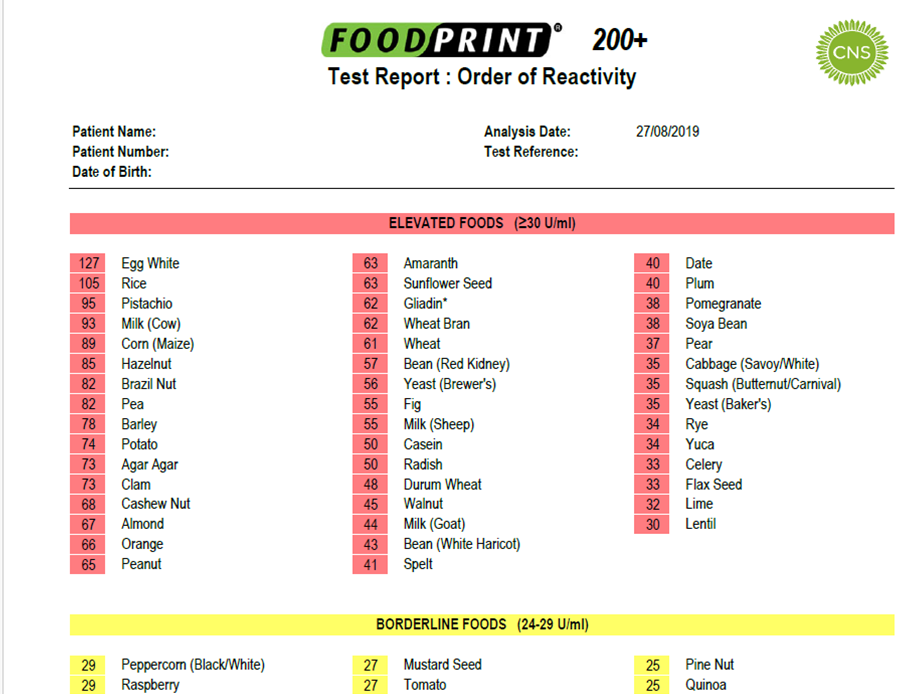
Above: test results from 2019. Below: test results from 2024.
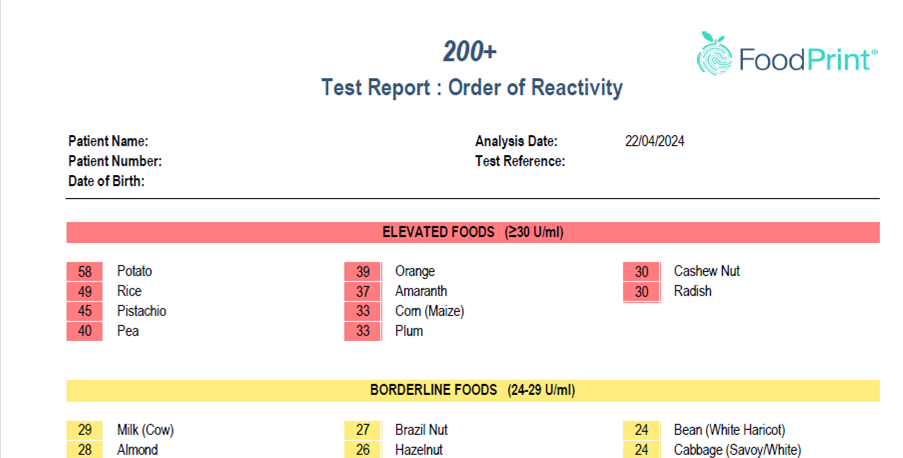
I was especially pleased to see that all of the ten remaining red list items had been on the original list – no new sensitivities had developed. This was a relief, as one annoying thing about making dietary changes for health reasons is that you sometimes make a big effort to start eating something new, only to discover that that too is problematic!
I am a cautious sort of person, so I have not jumped right into eating all of the old red foods again. In fact there are some that I will continue to avoid, simply because I know that they disagree with me in other ways (for example, they make me bloated or hurt my tummy). However, I have gently introduced soya milk and sheep’s cheese back into my diet and all seems to be well so far! I have also eaten a few things with nuts in. I am plucking up courage to try an egg, because eggs are great and I’d love to have them back in my life!
I was a bit sad to see peas and potatoes still on the list, because they’re so versatile – who doesn’t love a jacket potato, a roast dinner, or eating raw peas from the shell?! I was also disappointed to see corn and rice still there, because it is so much easier to find things to eat when you’re out and about if you can have cornflour or rice flour, which form the basis of most gluten-free baked goods. You know I subscribe strongly to the idea that we should not replace normal junk food with gluten-free junk food, but it would certainly make travelling easier if I could occasionally grab a gluten-free sandwich!
Nevertheless, I am very happy with my results and it has given me great peace of mind to know that no new IgG intolerances have developed. I cannot recommend CNS Lab highly enough and if you are struggling with any kind of chronic health condition I would urge you to invest in a FoodPrint200+ test. It might shave years of guesswork off your journey and help you to more completely address your symptoms. I will definitely use CNS Lab again in the future!
This blog post is the intellectual property of tinypioneer.co.uk and may not be copied or published elsewhere. You may share a link to the post if you wish.
Copyright © Tiny Pioneer 2024